The first thing most people do after buying a Jeep CJ is take it for a drive.
The first thing you should do is drain every fluid in it.
Engine oil. Transmission fluid. Transfer case fluid. Front and rear differentials. Coolant. Brake fluid. Every one of those fluids tells a story about what's happening inside components you can't see. On a vehicle that may be 40 or 50 years old, that information is more valuable than almost any aftermarket part you could buy.
Most used CJs come with unknown histories. Some have been meticulously maintained. Others have survived decades of questionable repairs, neglected service, and long periods of storage. A fluid change isn't simply routine maintenance: it's one of the most effective diagnostic tools available. Before spending money on upgrades, modifications, or cosmetic improvements, find out what the Jeep is trying to tell you.
Why Fluid Changes Should Be Step One
Every system on a CJ depends on what's happening internally. A differential that's quietly shedding metal doesn't care how nice your new tires are. An engine with coolant contamination won't be saved by a new carburetor. Brake fluid saturated with moisture won't suddenly become safe because the pedal feels acceptable.
Changing fluids establishes a baseline. It tells you what condition the major components are in, whether water contamination exists, whether excessive wear is occurring, and which systems deserve immediate attention. Think of it as gathering evidence before making decisions.
This is why the CJ Foundation Checklist puts fluid changes at Step 1. Everything downstream depends on what you find here.
| Fluid | Normal Condition | Warning Signs |
|---|---|---|
| Engine oil | Dark brown to black | Milky or gray, fuel smell, heavy sludge |
| Transmission fluid | Clean fluid, light metallic paste on magnet | Flakes, grit, milky fluid, low level |
| Transfer case fluid | Clean gear oil | Milky, flakes, low level |
| Front axle (Dana 30) | Dark gear oil | Metal particles, gray or milky fluid |
| Rear axle (AMC 20) | Dark gear oil | Flakes, chunks, heavy contamination |
| Brake fluid | Clear to light amber | Dark brown, cloudy |
| Coolant | Clean green, orange, or yellow | Rust, sediment, oil contamination |
Engine Oil: What the AMC Engine Is Telling You
Whether your CJ has the AMC 258 inline-six, AMC 304 V8, or AMC 360 V8, the engine oil is often the most revealing fluid in the vehicle. Drain it warm if you can. Warm oil carries contaminants in suspension and gives you a more accurate read on engine condition.
Dark oil on its own isn't a problem. Detergent oils are designed to hold contaminants in suspension, and a well-running engine that hasn't been serviced recently will produce dark brown to black oil. What matters is what else you find.
Milky or gray oil means coolant contamination. This can come from a failed head gasket, a cracked head, or an intake manifold gasket leak. On the AMC 258, intake gasket issues are common and can push coolant into the oil without causing obvious overheating first, which means the engine can be running "fine" while the contamination is doing damage.
A strong gasoline smell in the oil indicates fuel is getting past the rings or flooding through the carburetor. Fuel dilutes the oil and reduces its protection across the whole engine, not just the rings.
Heavy sludge points to long oil change intervals, extended storage, or excessive operating temperatures. Sludge restricts oil passages and creates lubrication problems throughout the engine that don't announce themselves until something fails.
Choosing Oil for AMC Flat-Tappet Engines
AMC engines use flat-tappet camshafts. The flat-tappet design places significant pressure between the cam lobe and the lifter (a small surface area under high load) and the oil has to carry an anti-wear additive called ZDDP (zinc dialkyl dithiophosphate) to protect that interface. Without adequate ZDDP, the cam lobe and lifter wear against each other. It is not a slow process.
Modern passenger car motor oils (anything rated API SM or newer) have had their ZDDP reduced to protect catalytic converters. This started around 2004 and has continued with each subsequent API rating. Whether your CJ has a catalytic converter depends on the year and configuration. Some models from 1975 onward were "Catalyst" equipped (look for a red sticker on the dash or under the hood), others were "Non-Catalyst" (black sticker). Either way, the reduced ZDDP levels in modern passenger-car oils remain a concern for flat-tappet engines regardless of catalytic-converter status.
A note on break-in vs. ongoing use: ZDDP matters most during the camshaft break-in period: the first few hundred miles on a new or freshly installed cam. That process uses a special oil with very high ZDDP and very low detergents. For an already-running engine, which is what most CJ buyers are dealing with, break-in happened at some point in the past. The risk is lower, but you cannot verify whether the cam was broken in correctly or what spring pressures are in there. Running adequate ZDDP on every oil change for the life of the vehicle is cheap insurance against something you cannot confirm.
The practical answer for most owners is Shell Rotella T4 15W-40, a diesel-rated oil that still carries adequate ZDDP, costs the same as regular motor oil, and is available at any auto parts store or Walmart. If you prefer to run a different oil, add a ZDDP supplement at each oil change. Valvoline VR1 and Driven Hot Rod Oil are purpose-made alternatives with higher zinc content if you want a dedicated flat-tappet formula. The target for ongoing use is roughly 1,000 ppm zinc.
The AMC 258 takes approximately 6 quarts with filter.
Manual Transmission Fluid: Getting the Spec Right
CJ transmissions vary by model year, and this is one area where getting the wrong fluid causes real damage. Identify your transmission before you refill it.
| Transmission | Correct Fluid |
|---|---|
| T150, T176, SR4 | 80W-90 GL-4 gear oil |
| T4 | ATF (Dexron/Mercon), not gear oil |
| T5 | ATF or dedicated synchromesh fluid |
The T150, T176, and SR4 were designed around GL-4 lubricants. While many modern GL-5 oils are formulated to be yellow-metal compatible, GL-4 still provides the synchronizer friction characteristics these transmissions were built to use, and it's the spec that eliminates any uncertainty. The T4 is a common source of confusion: it takes ATF, not gear oil. Gear oil in a T4 expands under heat, pressurizes the case, and blows the seals. If you're not certain which transmission is in your CJ, identify it before adding anything.
When you pull the drain plug, check the magnet. A light metallic paste is normal wear from years of operation. Visible flakes, chips, or anything gritty between your fingers is not: that indicates bearing damage, synchronizer wear, or worse, and deserves investigation before the Jeep is driven hard. Also check the fluid level before draining. A transmission that's been running low has been operating under stress, and whatever is inside reflects that.
Transfer Case: Dana 20 and Dana 300
Most CJs use one of two transfer cases: the Dana 20 through 1979, and the Dana 300 from 1980 onward. Both are durable, capable units when maintained correctly. The fluid specs are different and the difference matters.
Dana 20: 80W-90 GL-5 gear oil. This is a gear-driven unit and takes the same class of fluid as the differentials.
Dana 300: 75W or 80W-90 GL-4 gear oil specifically: not GL-5, not ATF. The Dana 300 has brass thrust washers that the sulfur content in GL-5 corrodes over time. This is the same chemistry that makes GL-5 a poor fit for the older manual transmissions. Same metal, same reaction. GL-4 is the correct spec here, and it matters.
When you drain either unit, check the plug magnet and run the fluid between your fingers. Fine metallic paste is expected. Anything you can see or feel as a flake or particle indicates accelerated wear. Also look for water contamination. Transfer cases frequently encounter water through damaged seals or degraded vents, and contaminated fluid will appear gray or milky. A dry or low transfer case is often the result of a leaking output seal, which is worth inspecting while you're already underneath the Jeep.
Front Axle: Dana 30
The Dana 30 front axle handles the job well on most CJs when it's not neglected. The inspection here is straightforward: drain the differential, check the plug magnet, and look inside with a light before refilling.
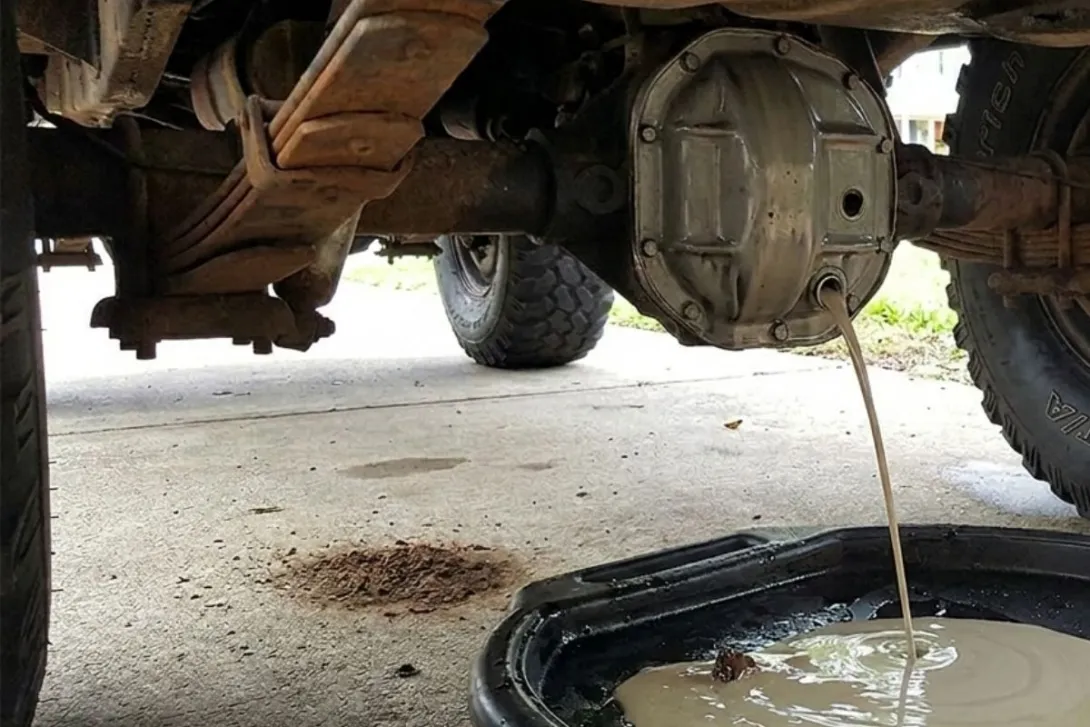
Fine metallic paste on the magnet is normal. Particles you can see or feel are not. Water contamination shows up as gray or milky fluid, sometimes with rust-colored residue. CJs get driven through streams and mud, and water intrudes through axle vents and dried-out seals over time. Water inside a differential moves quickly to the ring and pinion teeth and the bearings, so the sooner you find it and flush it, the better.
Refill with 75W-90 or 80W-90 GL-5 gear oil. Most Dana 30s in CJs do not have a limited-slip front locker, so friction modifier is not needed in the vast majority of cases.
AMC 20 Rear Axle: Why This Fluid Matters
The AMC 20 rear axle deserves more attention than a routine fluid change because it has a specific failure mode that makes the inspection more consequential here than on any other component.
The AMC 20 uses a two-piece axle shaft and hub design. These assemblies can loosen over time, and when the shafts fail, they can fail suddenly, on dry pavement during normal driving. The full failure mode is covered here. The point is that this axle rewards careful inspection, and the fluid change is an opportunity.
When you drain the rear differential, check the plug magnet carefully. Fine metallic material is expected. Chunks, flakes, or anything rough between your fingers is a warning worth taking seriously. If there's significant metal contamination, pull the cover and inspect the ring and pinion before putting miles on the Jeep. It costs nothing to look while you're already there.
Refill with 75W-90 or 80W-90 GL-5 gear oil. If the rear axle has a Trac-Lok limited-slip differential, check whether your GL-5 is already formulated for limited-slip use before adding friction modifier. Most modern GL-5 oils are LS-rated. Adding modifier to an oil that already contains it makes the Trac-Lok less effective.
Brake Fluid: The Most Overlooked Fluid on the Jeep
Many CJ owners inspect the engine carefully while completely ignoring the brake fluid. That's a mistake.
Brake fluid absorbs moisture from the atmosphere throughout its life. That moisture lowers the fluid's boiling point, which means that under hard braking or on a long descent, the fluid can boil before the pads do. A pedal that feels fine on a flat road can go soft or to the floor in exactly the conditions where you need it most.
Fresh brake fluid is clear to light amber. Old fluid darkens to brown. Severely contaminated fluid looks cloudy or milky. On a CJ with unknown service history, treat the brake fluid as contaminated regardless of what it looks like in the reservoir, and flush the entire system with fresh DOT 3 or DOT 4. Both are compatible, and DOT 4 offers a higher boiling point. Avoid DOT 5 unless the entire brake system has been specifically rebuilt for it. DOT 5 does not mix with DOT 3 or DOT 4, and it commonly produces a softer pedal feel in vintage brake systems.
While you're working through the brake system, look at every rubber brake hose. Cracks, swelling, softness, or visible deterioration are not deferred maintenance items: they're safety issues. Aged rubber hoses can collapse internally and restrict flow even when they look acceptable from the outside.
Coolant: What the Cooling System Is Hiding
Cooling systems on classic Jeeps often reveal years of neglect. Drain the coolant and pay attention to what comes out.
Healthy coolant is green, orange, or yellow depending on the formulation, and it should be relatively clear. Rust in the coolant (from light tinting to visible particles) indicates depleted corrosion inhibitors and internal corrosion working against the block and any aluminum components. Heavy scale or sediment points to mineral buildup, often from years of tap water use. Oil floating in the coolant means a head gasket or internal engine leak, and that conversation changes everything else you were planning to do.
The CJ cooling system has its own set of failure patterns worth understanding, but the baseline step here is simple: drain, flush with clean water until it runs clear, and refill with a 50/50 mix of fresh coolant and distilled water. Distilled water matters: the mineral content in tap water contributes to the scale buildup you're trying to get rid of.
If the coolant smells like oil, or the oil smells like coolant, note it and watch for it as you run the engine through its paces.
What to Do With What You Found
Once everything is drained, take stock before moving on.
If everything came out clean and within normal range, proceed to Step 2 with confidence. You know what's underneath the Jeep and you can make decisions accordingly.
If one or two systems look questionable, document what you found and monitor those systems as you drive. Some things (slightly darkened gear oil, minor surface rust in the coolant) are normal wear that a fresh fluid change addresses. Others bear watching.
If you found coolant in the engine oil, significant metal contamination in the differentials, or a brake system that clearly hasn't been touched in decades, address those before spending money anywhere else. The Jeep is telling you where the real problems are. Listen to it.
The fluid change costs you a few hours and the price of consumables. The information it provides is worth more than most of the parts you will ever buy for this Jeep.
What Comes Next
Step 2 covers rubber: every hose, boot, and bushing on the CJ. The rubber that was installed in 1978 has had forty-plus years to crack, harden, and fail. You found the fluid condition. Now you find the containment condition.
Continue to Step 2: Replace All Aged Rubber →
Or if you're still in the evaluation phase and haven't worked through all 10 systems yet, the CJ Foundation Checklist covers them in sequence.
Frequently Asked Questions
What fluid should a Dana 20 transfer case use?
The Dana 20 uses 80W-90 GL-5 gear oil, the same class as the differentials. The Dana 300 (1980-1986) uses GL-4 specifically, not GL-5, because the brass thrust washers inside corrode with GL-5's sulfur content.
Why is my Jeep CJ engine oil milky?
Milky oil indicates coolant contamination, typically caused by a failed head gasket, cracked cylinder head, or intake manifold gasket leak. On the AMC 258, intake gasket issues are common and can allow coolant to enter the oil before any overheating symptoms appear.
Is metal on a differential drain plug normal?
A small amount of fine metallic paste is expected after years of normal operation. Visible flakes, chips, or anything you can feel as grit between your fingers indicates abnormal wear and deserves a closer look with the cover off before driving the Jeep hard.
What brake fluid should I use in a Jeep CJ?
DOT 3 is the original factory spec. DOT 4 is an acceptable upgrade with a higher boiling point and is fully compatible with DOT 3. Do not use DOT 5: it is silicone-based, does not mix with DOT 3 or DOT 4, and commonly produces a soft pedal in vintage brake systems.
What oil should I use in a flat-tappet AMC engine?
Shell Rotella T4 15W-40 is the most accessible option: it's a diesel-rated oil that still carries adequate ZDDP and is available at any auto parts store. Alternatively, run any quality oil and add a ZDDP supplement at each oil change. The target for an ongoing, already broken-in engine is approximately 1,000 ppm zinc.