
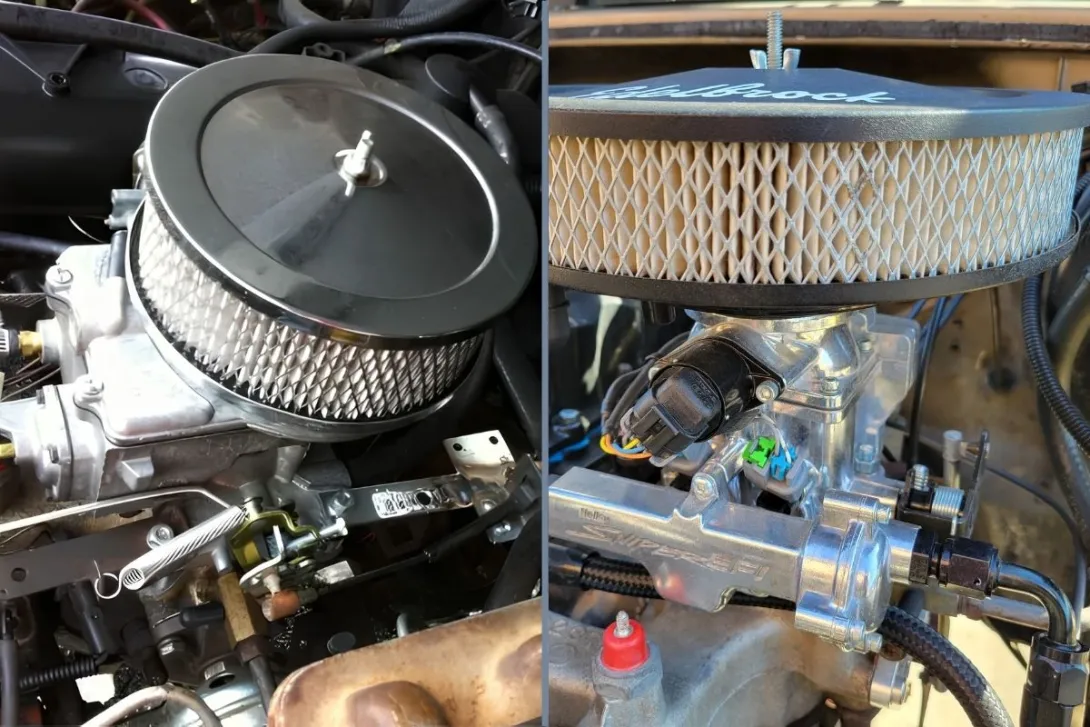
Carb vs. EFI, Real Costs, and What Actually Works on a CJ
The AMC 258 is one of the most forgiving engines Jeep ever built. It will tolerate vacuum leaks, questionable timing, weak ignition systems, old fuel, and years of neglected maintenance while still dragging a CJ down the trail. That durability is exactly why so many Jeep owners continue rebuilding and upgrading these engines decades later.
But once you decide to upgrade the fuel system, things get complicated quickly -- not because there are too many options, but because there actually aren't.
Unlike a small-block Chevy, the AMC 258 does not have a massive aftermarket intake ecosystem. Most carburetor upgrades require adapters. EFI systems vary wildly in complexity and support. Many combinations that sound impressive on paper perform poorly on a mostly stock inline-six.
This guide breaks down what actually works on a real-world CJ -- including hidden costs, adapter requirements, tuning realities, and upgrade paths worth avoiding entirely. Before diving in, make sure your fuel system is actually the weak link: the CJ Foundation Checklist walks through the systems that should come first.
The Constraint Most People Discover Too Late
Every fuel delivery decision on the AMC 258 starts with one limitation: the intake manifold.
The factory AMC manifold uses a unique bolt pattern that immediately narrows your options. Popular upgrades like the Weber 38 DGES and Motorcraft 2100 do not bolt directly to the stock intake -- they require adapter plates. True aftermarket intake choices exist, but only from a small number of manufacturers like Offenhauser and Clifford Performance.
Every added adapter, spacer, linkage conversion, or manifold swap introduces:
- Additional cost
- More tuning variables
- More potential vacuum leak points
- Greater installation complexity
Understanding the manifold situation first prevents one of the most common CJ mistakes: buying parts that technically fit together but perform worse once installed.
Bottom line: A large percentage of AMC 258 drivability complaints are not caused by the carburetor itself. Vacuum leaks, incorrect ignition timing, failing emissions controls, poor electrical grounds, and mismatched intake components are far more common culprits. Throwing parts at the engine without understanding the manifold setup usually makes things worse, not better.
Why Year Matters: AMC 258 Intake Manifold Differences
Before ordering anything, confirm which intake setup your engine actually has. AMC changed the 258 intake and exhaust design around 1980-1981.
Pre-1980 Engines
Earlier engines used a heavy cast-iron intake physically connected to the exhaust manifold underneath the carburetor. The intake and exhaust effectively function as one assembly.
1981-1990 Engines
Later engines switched to a lighter aluminum intake with separate intake and exhaust manifolds. Most modern upgrade paths assume this later aluminum 2-barrel manifold.
If you are working with an early CJ, verify your starting point before ordering adapters, EFI kits, or carburetors. One reason the Holley Sniper BBD exists at all is because it was engineered specifically around the factory AMC 2-barrel bolt pattern -- no adapter required, which immediately removes several common installation headaches.
The Real Cost of a Fuel System Upgrade
One of the biggest mistakes Jeep owners make is comparing only the sticker price of the carburetor or EFI unit. That number is rarely the real cost.
A "cheap" carburetor upgrade often requires:
- Adapter plates
- Linkage modifications
- Air cleaner changes
- Fuel pressure regulation
- Spacer plates and fuel line work
- Rejetting time
EFI systems add their own requirements:
- High-pressure fuel delivery
- O2 sensor installation
- Wiring cleanup
- Fuel return routing
- Electrical upgrades
Bottom line: Most CJ owners do not need a high-dollar performance fuel system. A properly sorted ignition system, healthy cooling system, correct gearing, and a well-tuned carburetor often transform how the Jeep drives long before EFI becomes necessary.
AMC 258 Fuel System Options at a Glance
| Option | What You Need | Manifold Change? | Best For |
|---|---|---|---|
| Rebuild Carter BBD | Rebuild kit, vacuum diagnostics | No | Originality, troubleshooting |
| Motorcraft 2100 | Carb, adapter plate, air cleaner | No | Best low-cost carb upgrade |
| Motorcraft 2150 | Carb, adapter plate, linkage adaptation | No | Carb setup for elevation changes |
| Weber 38 DGES | Adapter plates, regulator, hardware | No | Strong throttle response |
| Howell TBI EFI | Adapter plate, complete EFI kit, O2 bung | No | CARB-legal EFI path |
| Holley Sniper BBD | EFI unit, pump, O2 bung | No | Best stock-manifold EFI solution |
| 4-Barrel Intake + Carb | Intake manifold, carb, linkage | Yes | Traditional performance build |
| 4-Barrel Intake + Sniper 4150 | Intake, EFI kit, fuel system | Yes | Maximum-performance EFI build |
Carburetor Upgrade Paths
For many CJ owners, staying carbureted still makes the most sense. A properly sorted carburetor setup is simple, trail-fixable, and completely capable of running well when the ignition and vacuum systems are healthy.
The key is matching the carburetor to what the AMC 258 actually is: a low-RPM torque engine, not a high-revving horsepower platform. That distinction matters more than most upgrade guides admit.
Option 0: Rebuild the Carter BBD
The Carter BBD has earned a terrible reputation -- and some of it is deserved. But much of the criticism comes from carburetors dealing with decades of neglect rather than fundamental design failure.
Most surviving BBD systems are contending with:
- Vacuum leaks and worn throttle shafts
- Cracked or disconnected emissions lines
- Failed stepper motors on 1982-1986 feedback versions
- Incorrect ignition timing
- Decades of deferred tuning
A properly functioning Carter BBD can drive reasonably well on a mostly stock AMC 258. The problem is that very few are still operating the way AMC originally intended. In many cases, owners who rebuild the BBD discover the carburetor itself was never the root problem.
When Rebuilding Makes Sense
- The Jeep still has intact emissions equipment
- Originality matters to the owner
- The engine is otherwise stock
- You are still diagnosing broader drivability issues
- You need a lower-cost short-term solution
Honest Limitations
Even a correctly functioning BBD comes with real drawbacks:
- Complex emissions controls that are increasingly hard to service
- Computer-controlled mixture systems sensitive to sensor condition
- High sensitivity to vacuum leaks
- Limited aftermarket support
That is why many CJ owners eventually move toward Motorcraft conversions, Weber setups, or EFI -- not because the BBD cannot run well, but because the alternatives are simpler to live with long term.
Best for: Mostly stock CJs, restoration-minded owners, emissions-retained builds, and diagnosing system-wide drivability issues.
Related: Before you replace that Carter BBD, try this first
Option 1: Motorcraft 2100
If you want the simplest upgrade that genuinely improves drivability, the Motorcraft 2100 is difficult to beat. Originally used on Ford V8s and some AMC applications in the 1970s, it earned its reputation for being durable, easy to tune, and unusually tolerant of off-road angles.
Most importantly: it fixes nearly every drivability complaint associated with the Carter BBD without introducing EFI-level complexity.
Why the 1.08 Venturi Matters
The correct version for the AMC 258 is the 1.08 venturi model, which flows roughly 287 CFM. Larger versions exist, but bigger is not better on a mostly stock inline-six. Oversized carbs weaken throttle response and make tuning unnecessarily difficult in the lower RPM ranges where the 258 spends most of its life.
The venturi size is stamped inside a small circle on the driver-side body casting.
What Installation Requires
This is not a direct bolt-on. You will need an adapter plate, minor throttle linkage modification, and a compatible air cleaner setup. The install remains straightforward compared to most EFI conversions.
Where It Excels
- Reliable idle quality
- Good cold starts
- Strong low-end drivability
- Excellent trail manners
- Minimal tuning complexity
One Downside
Most original 2100s now come from junkyards or marketplace sellers. Condition varies significantly, so confirming the correct venturi size before buying matters.
In summary: A properly sorted Motorcraft 2100 often delivers 80% of the drivability improvement most CJ owners want, for a fraction of the cost and complexity of EFI.
Best for: Reliable trail Jeeps, budget-minded upgrades, daily-driven carbureted CJs, owners who want simplicity.
Option 2: Motorcraft 2150
For owners who regularly drive between dramatically different elevations, the Motorcraft 2150 deserves a look. It is essentially an evolved version of the 2100 with additional emissions-era features, including an altitude compensator on some versions that automatically adjusts mixture for changing elevation -- a feature that becomes genuinely useful in mountainous terrain.
Advantages Over the 2100
- Better mixture compensation at elevation
- Similar low-end drivability
- Strong low-RPM torque characteristics
Drawbacks
- More vacuum ports to manage
- More emissions hardware
- Slightly more complicated tuning
- Harder to install cleanly
Best for: Mountain-state Jeeps, frequent elevation changes, owners committed to carburetion.
Option 3: Weber 38 DGES
For owners who want to stay carbureted but want sharper throttle response than the Motorcraft provides, the Weber 38 DGES has developed a loyal following in the CJ community. It makes the engine feel more responsive and lively compared to the factory setup.
Why the 38, Not the 32/36
The 38 DGES flows roughly 300 CFM and uses synchronous throttle operation -- both barrels open together. That setup works better with the AMC 258 than the smaller 32/36 progressive Weber, which many owners find undersized in a full-weight CJ.
Installation Reality
The Weber does not bolt directly to the stock AMC manifold. Most kits include two-piece adapter plates, an air cleaner, and mounting hardware. Careful installation matters -- overtightening the adapter hardware can strip aluminum threads surprisingly easily.
Fuel Pressure Is Critical
Webers are extremely sensitive to fuel pressure. Anything above roughly 3-5 PSI causes flooding and inconsistent operation. A fuel pressure regulator is mandatory, not optional.
Best for: Sharper throttle response, street-oriented CJs, owners comfortable tuning carbs.
EFI Upgrade Paths
At some point, many CJ owners get tired of fighting carburetor behavior. Cold starts, vapor lock, altitude changes, steep-angle drivability, and inconsistent idle are exactly why EFI conversions became popular in the Jeep world. For many owners, EFI permanently solves problems they have been chasing for years.
The trade-off is cost and complexity.
Option 4: Howell TBI EFI
Howell EFI converts the AMC 258 to fuel injection using GM-based components and a remanufactured GM throttle body calibrated specifically for the inline-six. Unlike the Holley Sniper BBD, the Howell system uses an adapter plate to mate the GM throttle body to the AMC intake pattern -- an additional gasket surface and mounting layer compared to the direct-mount Sniper setup.
Where Howell Makes Sense
The biggest advantage is emissions legality. Howell offers a CARB-legal version for earlier CJs, making it the only EFI path in this guide capable of passing visual emissions inspections in stricter states.
The Reality About the Technology
This is older GM OBD1-era EFI. It is durable and proven, but clearly older compared to modern self-learning systems. Tuning changes require logging data, sending files to Howell, receiving a revised chip, and physically swapping the ECU chip. It works -- but it is not modern tuning convenience.
In summary: Compared to newer self-learning EFI systems, installation is less integrated, tuning flexibility is more limited, and support relies heavily on Howell directly. Worth it specifically if emissions legality is a requirement.
Best for: Emissions-regulated states, owners prioritizing proven reliability over modern convenience.
Option 5: Holley Sniper BBD
The Holley Sniper BBD exists because Holley recognized a gap: most EFI systems required adapters or manifold changes. The Sniper BBD mounts directly to the factory AMC manifold pattern with no adapter required -- cleaner installation than most alternatives right out of the box.
What the System Still Requires
- High-pressure fuel delivery (the stock mechanical pump will not work)
- EFI-compatible fuel plumbing
- O2 sensor installation
- Electrical cleanup
What Self-Tuning Actually Means
The Sniper self-learns to a functional baseline, which dramatically improves cold starts, altitude compensation, vapor lock resistance, and overall drivability. Fully optimizing performance still rewards manual tuning work inside the fuel and timing tables.
Sniper BBD vs. Sniper 2300
Many AMC 258 owners assume the larger Sniper 2300 is the better choice. It often is not. The Sniper BBD's smaller throttle bores are well matched to the personality of the AMC inline-six, delivering smoother throttle modulation, better low-speed crawl control, less abrupt pedal tip-in, and more factory-like drivability. The Sniper 2300 offers greater airflow potential and broader compatibility, but on a mostly stock 258, many owners prefer the calmer feel of the BBD.
In summary: The AMC 258 rarely needs enormous airflow. For most trail and street Jeeps, throttle control and drivability matter more than maximum CFM numbers.
Best for: Mostly stock AMC 258 builds, trail-oriented Jeeps, drivers prioritizing smooth low-speed control.
Performance-Oriented Builds
Once you move into aftermarket manifolds and aggressive EFI or carburetor combinations, you are no longer fixing drivability problems. You are building a performance engine. That changes the economics of the project considerably.
Option 6: 4-Barrel Intake + Carburetor
Replacing the stock intake with an Offenhauser or Clifford 4-barrel manifold opens the door to traditional performance carburetor setups. But this is also where many AMC 258 builds accidentally become mismatched combinations.
Carburetors That Actually Work
Two combinations consistently work on the AMC 258 with a 4-barrel manifold: the Holley 390 vacuum secondary and the Holley Truck Avenger 470. Vacuum secondaries matter because the AMC 258 does not generate V8-level airflow demand. Oversized carbs hurt drivability far more often than they help performance.
The Common Mistake
A 600 CFM carburetor on a mostly stock AMC 258 is almost always too much. The engine cannot use the airflow efficiently below 4,000 RPM -- where most CJs spend their lives. The result is bogging, fuel drop-out, weak throttle response, and inconsistent drivability.
Best for: 4.0 HO head swaps, camshaft upgrades, higher RPM builds, dedicated performance projects.
Option 7: 4-Barrel Intake + Holley Sniper 4150
If you have already committed to a 4-barrel intake, the Holley Sniper 4150 is the mechanically correct EFI pairing. It mounts directly to the standard square-bore flange without adapters.
Some owners attempt to run a Sniper 2300 on a 4-barrel intake using reducers and adapter plates. That defeats the purpose of the manifold upgrade while adding leak points, airflow disruption, and tuning variables. If you have a 4-barrel intake, use the correct EFI platform.
The Throttle Sensitivity Problem
The Sniper 4150 flows substantially more air than a typical AMC 258 can realistically consume. The large four-barrel throttle blade area creates sensitivity issues on a low-displacement inline-six: abrupt throttle response, touchy low-speed modulation, jerky crawl behavior, and more difficult throttle control off-road.
This is why many experienced AMC 258 owners prefer a properly matched 2-barrel intake paired with a Sniper BBD or Sniper 2300. The smaller throttle bores deliver smoother, more progressive drivability while still providing all the airflow most modified inline-six builds realistically need.
In summary: If you are still planning the build, a properly matched 2-barrel EFI setup is often the better overall combination. If you already own a 4-barrel intake, the Sniper 4150 is the cleaner solution than adapting a 2-barrel unit onto it.
Best for: Fully built AMC 258s, 4.0 HO head swaps, street-performance CJs.
The 4.0 HO Head Swap
Nearly every serious AMC 258 build eventually arrives at this topic. A properly executed 4.0 head swap is one of the most effective airflow upgrades available for the AMC inline-six. Better port design improves breathing dramatically, increases compression slightly, and can produce 30-40 horsepower gains on a well-matched build.
Despite how casually the internet describes it, this is not a simple bolt-on upgrade.
Which Head to Use
- Casting #7120 (1991-1995): Generally the best overall head for performance builds.
- Casting #0630 (1996-1999): Excellent option with very similar airflow characteristics.
- Casting #0331 (2000+): Avoid. Known for cracking between cylinders 3 and 4, smaller exhaust ports, reduced performance potential.
Cooling Passage Differences
The 4.0 head contains additional coolant passages that do not fully align with the narrower 258 block deck. Many experienced builders fill unused portions of the coolant passages using JB Weld, Devcon, or similar high-temp epoxies. Surface prep, cure time, and deck flatness all matter. Machine shop quality becomes critical here.
Head Bolt Differences
The AMC 258 block uses 7/16-inch head bolts. The 4.0 head is machined for 1/2-inch bolts. Standard 258 hardware does not properly center the head. Most builders use step-shank conversion bolts or precision alignment bushings. This is not an area to improvise.
Valvetrain Geometry
The 258 valvetrain is non-adjustable, so pushrod length must be correct. Once deck height, valve jobs, gasket thickness, and rocker geometry change, the original pushrod length is often no longer right.
- Pushrods too long: Valves may not fully close, causing compression loss and burned valves.
- Pushrods too short: Excessive valvetrain noise and improper lifter preload.
Experienced builders verify preload using adjustable checking pushrods during mock-up assembly.
Manifold Compatibility
The intake and exhaust ports on the 4.0 head sit significantly higher than those on the original 258 head. The original manifolds will not align correctly. Plan for a Jeep 4.0 intake manifold or Clifford/Offenhauser aftermarket intake, plus a 4.0 exhaust manifold or 4.0-compatible header. These are often the hidden costs that push the project beyond the original budget.
In summary: Once the 4.0 head goes on, the supporting modifications usually follow -- header, intake changes, EFI upgrades, cooling improvements, ignition upgrades, additional tuning. At that point, the project stops being a fuel system upgrade and becomes an engine build.
When a V8 Swap Enters the Conversation
If your goal is better drivability, easier cold starts, improved reliability, and strong trail torque, the AMC 258 is absolutely worth upgrading.
But if the goal is substantial horsepower or modern V8-style acceleration, there is a point where the economics stop favoring the inline-six. A heavily modified 258 -- 4.0 head, EFI, header, camshaft, intake upgrades, custom tuning, machine work -- can become expensive quickly. At that level of investment, many owners start comparing the total cost against AMC 360 swaps, Chevy 350 conversions, or LS platforms. From a horsepower-per-dollar standpoint, the V8 usually wins.
The best AMC 258 builds succeed because they preserve what makes the inline-six enjoyable: smooth torque delivery, crawl control, predictable traction, relaxed cruising, and mechanical simplicity. The moment the objective becomes "I want modern horsepower," the economics shift toward a V8 quickly.
Bottom line: Improving an AMC 258 and building the fastest possible CJ are usually two very different projects.
How to Choose the Right Setup
Once you stop comparing individual parts and start thinking about how the Jeep is actually used, the decision gets simpler.
| If You Want... | Choose... |
|---|---|
| Lowest-cost reliable upgrade | Motorcraft 2100 |
| Originality | Rebuild the Carter BBD |
| Better high-altitude drivability | Motorcraft 2150 |
| Sharper throttle response | Weber 38 DGES |
| Best stock-manifold EFI | Holley Sniper BBD |
| Emissions legality | Howell TBI |
| Serious inline-six performance | 4.0 HO head + properly matched EFI or carb |
| Maximum horsepower-per-dollar | Consider a V8 swap |
The Worst Combination in This Guide
A large 4-barrel carburetor on a mostly stock AMC 258.
This setup appears constantly on forums and marketplace builds because people assume bigger carburetor equals more power. On a stock or near-stock 258, the long-runner Offenhauser and Clifford manifolds require higher RPM airflow to keep fuel atomized properly. Most street-driven CJs rarely operate in that range.
The result is usually surging, fuel puddling, bogging, weak low-end response, and inconsistent tuning. The 4-barrel path only starts making sense once the rest of the engine can actually support it.
One Final Note
Fuel delivery is only one part of how the AMC 258 behaves. A carburetor or EFI upgrade installed on top of weak ignition timing, poor electrical grounds, marginal cooling, vacuum leaks, or incorrect gearing will never perform the way the parts are capable of.
The best-running CJ builds get the fundamentals right first -- electrical system, ignition timing, cooling capacity, vacuum integrity, drivetrain gearing. Then the fuel system upgrade finally works the way it was designed to. And if the Jeep still runs poorly afterward, the carburetor is usually the last place to look.
See the full CJ build sequence for the correct order of operations.
Related: Before you replace that Carter BBD, try this first | Build an honest electrical foundation